


Mold on cannabis has three faces: bud rot (botrytis) eats its way invisibly into the core of dense buds, powdery mildew settles as a white, floury coating on the leaves, and storage mold appears when buds go into the jar too wet. All three have the same cause: humidity that is too high and air that doesn’t move. If you spot the signs early, you can usually save most of the harvest.
In this guide you will find a table “what you see → what it is → what to do”, what mold on weed looks like and how to tell it apart from trichomes, how to deal with bud rot and powdery mildew, and a prevention plan by growth stage — with an eye on the wet autumn that growers in the UK, Europe, Canada and much of the USA know only too well.
What does mold on weed look like? The overview
Most growers notice mold (mould in British English) too late because they look in the wrong place. Bud rot sits inside the bud, powdery mildew starts on the upper side of the leaves, and storage mold only shows up in the jar. This table helps with a quick diagnosis:
| What you see | What it is | Stage | What to do |
|---|---|---|---|
| Single brown, dry little leaves sticking out of an otherwise healthy bud | Bud rot (botrytis) inside | Early stage | Open the bud, cut out the affected part generously |
| Grey, fluffy coating inside the bud, the bud feels soft | Bud rot (botrytis) | Advanced | Remove the whole bud, check the neighbouring buds |
| White, floury spots on the upper side of the leaves that wipe off | Powdery mildew | Early to medium | Remove affected leaves, lower the humidity |
| Yellowish spots on top, greyish fuzz on the underside of the leaf | Downy mildew | Early to medium | Remove affected leaves, keep the plant drier |
| Musty smell of a cellar or wet hay in the jar | Storage mold | Starting | Take the buds out at once and check each one |
| White-grey threads or fuzz on dried buds | Storage mold | Visible | Throw the affected buds away |

Mold or trichomes? How to tell them apart
White doesn’t always mean mold. Ripe buds in particular are covered in trichomes, which from a distance look like a pale coating. Under a loupe (30–60×) the difference is clear:
- Trichomes stand individually on short stalks and carry a round, shiny head — clear, milky or amber. They are spread evenly across the bud and sugar leaves.
- Mold forms fine, interwoven threads without heads, looks dull, fluffy or like cotton wool and often sits in just one spot — usually inside or at the base of the bud.
If in doubt, the smell test helps: healthy buds smell of their terpenes; mold smells musty, like a cellar or wet hay. What ripe trichomes look like is shown in detail in our guide When to harvest cannabis.
Bud rot (botrytis): rot from the inside
Bud rot, also called grey mold, is caused by the fungus Botrytis cinerea. It gets in wherever moisture stays put: inside big, dense buds, around the stem. From the outside the bud often still looks healthy — by the time the grey fuzz becomes visible, the core is already destroyed.

How to spot bud rot early
- A single sugar leaf in the bud suddenly turns brown and dry while the rest stay green.
- A bud droops or feels softer in one spot.
- Pistils turn brown and mushy in one spot instead of curling in.
Open suspicious buds carefully with your fingers or clean scissors. If the stem inside is brown and covered in grey fuzz, it is bud rot.
Why autumn is bud rot season
Botrytis loves cool nights, dew and rain at temperatures around 15–20 °C (59–68 °F) — exactly the weather of September and October in the UK, Ireland, central and northern Europe, the Pacific Northwest and the northeastern USA. Outdoor plants that only ripen in mid-October spend their last weeks in ideal fungal weather. The dense top colas of big indica strains are most at risk, because rainwater does not dry out of them for days.
What to do about bud rot
- Cut generously: cut off the affected bud 2–3 cm (about an inch) beyond the visible infection, ideally without shaking it — otherwise the spores spread to healthy buds.
- Straight into a bag: cut the affected bud off over a bag and seal it immediately. Don’t compost it — the spores survive in compost and come back next year.
- Clean your tools: wipe the scissors with alcohol after every cut.
- Check neighbouring buds daily: botrytis spreads quickly in damp nights.
- Harvest earlier: shortly before ripeness, harvesting a few days early is almost always better than waiting out a week of rain.
Powdery mildew on cannabis: how to spot and treat it
Mildew is the second big fungus on cannabis — and unlike bud rot, you can see it early. There are two forms, which differ in appearance and in the conditions they like.

| Powdery mildew | Downy mildew | |
|---|---|---|
| Appearance | White, floury spots, as if dusted with icing sugar | Yellow to brownish spots on top, greyish fuzz underneath |
| Where | Upper side of the leaf, later stems and buds | Underside of the leaf |
| Conditions | Warm days, cool nights, still air — even at moderate humidity | Wet and cool, leaves stay damp for a long time |
| Wipes off? | Yes, it can be wiped away with a finger | No |
White spots on cannabis leaves: what to do
- Remove affected leaves at once and put them in a closed bag.
- Move the air: a fan, more space between plants, thin out the lower leaves.
- Lower the humidity — to 40–50% in flowering.
- In the vegetative phase products based on potassium bicarbonate or neem oil, sprayed on the leaves, help. Don’t spray any more once flowering has started — residues stay in the buds, and moisture encourages bud rot.
Can powdery mildew go away? Not by itself. The visible spots can be removed, but the fungal network stays on the plant as long as the conditions suit it. The spread only stops once humidity and air movement are right. If mildew has already reached the buds, those buds are lost.
Moldy buds after harvest: mold when drying and storing
The third danger comes after the harvest. Fresh buds are three-quarters water — if they dry too slowly or go into the jar too early, they mold from the inside. The limit is humidity: above 65% in the jar you are in the red zone.
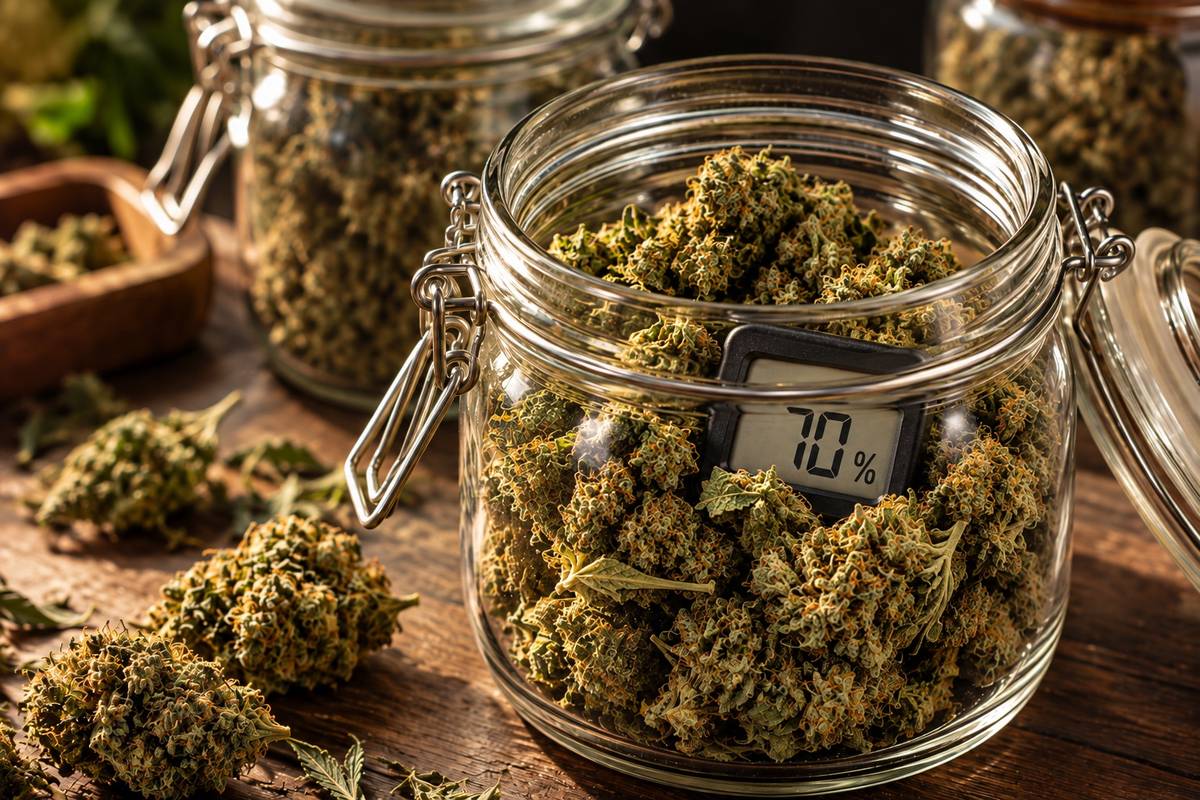
- When drying: 18–21 °C (64–70 °F) and 50–60% humidity, gentle air movement, don’t hang too densely.
- Into the jar only after the stem snap test: thin stems must snap when bent.
- In the jar: target 58–62%, air the jars every day in the first week. If the value climbs above 65%, take the buds out for a few hours.
- A musty smell when you open the jar is an alarm signal — check every bud individually.
How long does it take for weed to mold?
Faster than many think. Damp buds in a closed jar can smell musty after just two to three days at room temperature; visible fuzz often follows within a week. On the plant, bud rot can spread from one bud to its neighbours within a few days in wet autumn nights. Properly dried and cured buds at 58–62% humidity in the jar, on the other hand, stay stable for months as long as they are stored dark and cool.
All the values and methods in detail are in our guide How to dry and cure weed.
How to prevent mold: humidity by growth stage
With mold, prevention is the only truly effective strategy. The most important lever is humidity — it has to fall with every stage.
| Stage | Humidity | What to watch |
|---|---|---|
| Seedling and clone | 65–75% | Humid is intended here, but keep the air moving |
| Vegetative | 55–65% | Space between plants, thin out lower shoots |
| Early flowering | 45–55% | Fans below and above the canopy |
| Late flowering (last 2–3 weeks) | 40–45% | Densest stage, highest bud rot risk |
| Drying | 50–60% | Dark, 18–21 °C (64–70 °F), don’t hang too densely |
| Curing in jars | 58–62% | Above 65%, air the jars at once |
Indoors
- An extractor with enough capacity and a circulation fan — no still air in the canopy.
- Defoliation: remove big fan leaves that cover buds in week 3 of flowering.
- Water in the morning, not in the evening — wet soil during the dark period raises humidity.
- At night the temperature drops and the relative humidity rises: run the dehumidifier during the dark period.
Which temperature and humidity suit each week of flowering is shown in our guide Cannabis flowering stage week by week.
Outdoors in a wet climate
- Rain cover: a simple canopy or plastic cover over the plant in the last weeks of flowering keeps rain off the buds.
- Shake the buds after rain: shake gently so water doesn’t stay inside the buds.
- Choose the right strain: the earlier a strain is finished, the fewer weeks it hangs in the autumn rain. Loose sativa buds dry off faster after rain than compact indica buds.
Please note: Pyramid Seeds sells cannabis seeds as collectible items, and the growing information on our site is for educational purposes only. Whether you may germinate seeds and grow plants depends on the law in your country, and the rules differ widely — please check the regulations that apply where you live before growing.
Can you save moldy weed — or still smoke it?
Saving it: partly. If only one bud is affected, cut it out generously; the rest of the plant can still be used if you find no signs on the other buds. Buds with visible mold cannot be “cleaned” — washing, drying or heating does not make them good again.
Smoking it: no. Moldy buds belong in the bin, not in the grinder — that goes for bud rot, mildew on the buds and storage mold alike.
Strains that finish before the autumn rain
No strain is immune to mold — but you can influence how long your plants are exposed to the risk. Strains that ripen in late August or early September avoid the wettest part of a northern autumn almost completely.
- Fast versions: photoperiod strains with one to two weeks shorter flowering — for example Gorila Fast with 51 days of flowering.
- Early indica: Anubis seeds — 70% indica with only 48 days of flowering, ready outdoors as early as the 1st–2nd week of September. Shake the compact indica buds well after rain.
- Mould-resistant genetics: Black Cherry Punch is mould-resistant and ready outdoors in September — still keep humidity below 50% in late flowering.
- Autoflowering: independent of day length; sown from May, they are ready in late summer — for example Auto Alpujarreña, about 50–55 days after germination.
- Sativa-dominant strains with looser buds for windy, rainy spots — they ripen later, but dry off faster after rain.
Fast-flowering strains from our own breeding in Barcelona, with a germination guarantee and discreet shipping to the UK, Europe, the USA, Canada and worldwide.
No light switch, a short cycle — ideal for balconies and gardens in short, wet seasons.
For damp, windy spots it is also worth taking a look at our sativa seeds.
FAQ: Bud rot and cannabis mold
What does mold on weed look like?
Mold forms dull, fluffy threads without heads — white, grey or greenish, often like cotton wool — and usually sits in one spot, inside or at the base of a bud. With bud rot, single little leaves in the bud turn brown and there is grey fuzz inside at the stem. Powdery mildew shows up as a white, floury coating on the leaves that wipes off.
How can I tell if my weed is moldy?
Take a close look with a loupe (30–60×) and smell the bud. Mold forms dull, fluffy threads without heads and smells musty, like a cellar or wet hay. Healthy buds smell of their terpenes, and the white you see on them is made of trichomes standing individually with shiny round heads.
Mold or trichomes — how do I tell them apart?
Trichomes stand individually on short stalks, have a round, shiny head and are spread evenly over the bud. Mold forms interwoven, dull threads without heads and usually sits in one spot, often inside the bud.
What causes bud rot?
The fungus Botrytis cinerea. It thrives where moisture stays inside dense buds — in cool, damp nights, dew and rain at around 15–20 °C (59–68 °F), or indoors when humidity is too high and the air does not move. Late outdoor harvests in a wet autumn are most at risk.
Can you save moldy weed?
Partly. Cut out affected buds 2–3 cm beyond the visible infection and throw them away in a sealed bag. The rest of the plant can still be used if the other buds show no signs. Buds with visible mold cannot be saved by washing, drying or heating.
Can you still smoke moldy weed?
No. Moldy buds belong in the bin, not in the grinder — that goes for bud rot, mildew on the buds and storage mold alike.
What should you do about bud rot just before harvest?
Remove affected buds generously straight away without shaking the plant, and check the other buds every day. If the plant is almost ripe and more rain is forecast, it is usually better to harvest a few days early than to leave the harvest to the fungus.
Can powdery mildew go away?
Not by itself. Affected leaves can be removed, but the fungal network stays on the plant as long as humidity and air movement are not right. With more air movement, lower humidity and — in the vegetative phase — products based on potassium bicarbonate, the spread can be stopped. Mildew on the buds makes those buds unusable.
How do you prevent mold when drying and curing?
Dry at 18–21 °C (64–70 °F) and 50–60% humidity with gentle air movement, and only put the buds into jars once thin stems snap. In the jar, keep humidity at 58–62% and air the jars daily in the first week; above 65%, take the buds out for a few hours.
Read also


Strains from this article
- -15%



Comments
No comments yet. Be the first.