


Cannabis is ready to harvest when 70–80% of the trichomes are milky-cloudy and 10–20% have turned amber — not when the calendar says so. The resin glands under a loupe are the only reliable signal; brown pistils and yellowing leaves only confirm it. Cut two to three weeks too early and you give away up to 30% of potency and yield.
In this guide we show you the three signs of ripeness, a table of harvest times by strain type — with the real flowering times of our own strains — and an outdoor harvest calendar for short and long growing seasons. How autoflowering and photoperiod strains differ in general is explained in our guide to autoflowering seeds.
How to tell when weed is ready to harvest: trichomes, pistils, leaves
A cannabis plant shows its ripeness in three places. Only one of them is precise — the other two help you read the trend.
1. Trichomes under a loupe (the deciding signal)
Trichomes are the tiny resin glands on the buds and sugar leaves where cannabinoids and terpenes are made. With a loupe (30–60×) or a USB microscope you can see their colour — and the colour tells you how ripe the plant is:

| Trichome colour | What is happening in the plant | Harvest? |
|---|---|---|
| Clear / glassy | THC is still building up, terpenes incomplete | No — too early, thin effect, small yield |
| Milky / cloudy (70–80%) | THC at its peak, full terpene profile | Yes — the ideal window |
| Amber (10–20% mixed in) | THC starts to break down into CBN | Yes — a slightly heavier, more physical effect |
| Mostly amber / brown | Clear THC breakdown, aroma flattens | Too late — only damage control |
Check the trichomes directly on the buds, not only on the big sugar leaves — they ripen earlier there and suggest a harvest date that is too early. Check several spots on the plant, because the top buds are usually further along than the lower ones.

2. Pistils: the hairs turn brown
The white hairs (pistils) of the female flower turn orange to brown as the plant ripens, and curl in. As a rule of thumb, 70–90% brown, curled pistils indicate ripeness. But be careful — pistils also react to stress, heat or being touched and then change colour too early. They are a hint, not proof.

3. Leaves and calyxes
Towards the end of flowering the plant stops feeding the big fan leaves: they turn yellow and drop. At the same time the calyxes swell and the buds look dense and “fat”. This is normal and intended — yellow leaves in week 8 are not a nutrient deficiency but a sign of ripeness.
When to harvest cannabis: harvest time by strain type
The flowering time in the strain description is the frame; the trichomes are the fine-tuning. This is how long each strain type flowers on average — and how long our own strains take:
| Strain type | Typical flowering time | Example from our catalogue |
|---|---|---|
| Autoflower | 8–11 weeks from germination (whole cycle) | Auto Tutankhamon: 70 days from germination, 21–25% THC |
| Fast version (photoperiod) | 6–7 weeks of flowering | Galaxy Fast: 48 days (as little as 45 under LED), 70% indica |
| Indica-dominant | 7–9 weeks of flowering | Anesthesia: 48 days under LED, 90% indica |
| Hybrid | 8–10 weeks of flowering | Tutankhamon: 60 days (LED: 53 days), 26% THC — lab record 33% |
| Sativa-dominant | 10–12 weeks of flowering | Amnesia Gold: 65–75 days, 75% sativa |
Two rules for reading these figures. First, for photoperiod strains flowering time counts from the switch to 12/12 hours of light; for autoflowers it counts from germination. Second, the shorter LED figure only applies with enough light output — under weak light every strain takes longer. Start checking with the loupe about two weeks before the stated date. What happens to the plant in the weeks before is shown in our guide Cannabis flowering stage week by week.
Northern Lights: when to harvest the classic
Northern Lights is one of the most searched strains when it comes to the right harvest time — because it is so fast that many growers cut too early. Our Northern Lights (Afghani × Thai, 90% indica) flowers for 55 days (70 days from germination); outdoors in the northern hemisphere it is ready in early September. Auto Northern Lights is finished 70 days from germination. For both: the buds look “done” early because they are so compact — still wait for the milky trichomes, or the typical heavy indica feel will be missing.
When to harvest weed outdoors: short and long seasons
Outdoors it is not only the strain that decides, but the weather. In regions with a short season the autumn is brief: from mid-September temperatures fall, and from October come long spells of rain, fog and the first frosts — and with them bud rot in dense buds. The calendar below is for the northern hemisphere.
- Late August – mid-September: autoflowers and fast versions are ready. They are the safe choice for balconies and gardens in the UK, Ireland, northern and central Europe, Canada and the northern USA.
- Mid to late September: fast indicas such as Anesthesia or Northern Lights (1st–2nd week of September) and hybrids such as Tutankhamon (mid to late September).
- October: sativas such as Amnesia Gold (2nd–3rd week of October). From here on the risk rises: check daily for bud rot and, if a long spell of rain is forecast, rather harvest a few days early.
Short season (the UK, Ireland, Scandinavia, Canada, the northern USA, upland areas): plan with strains that are finished by mid-September. That is exactly why we bred the fast-flowering feminized seeds: the same genetics, ready one to two weeks earlier. Even more flexible are autoflowering seeds, which you can sow from May to July and harvest in late summer.
Long season (southern Europe, California and the southern USA): late sativas such as Amnesia Gold have the time to finish, and the harvest dates above can come a little earlier in a warm autumn.
Please note: Pyramid Seeds sells cannabis seeds as collectible items, and the growing information on our site is for educational purposes only. Whether you may germinate seeds and grow plants depends on the law in your country, and the rules differ widely — please check the regulations that apply where you live before growing.
Harvesting too early or too late: what changes
The harvest time is a dial you can use to steer effect and aroma. Harvesting early or late on purpose is fine — doing it by accident is not.
| Too early (clear trichomes) | Ideal (milky + some amber) | Too late (mostly amber) | |
|---|---|---|---|
| Effect | Thin, edgy, short | Full, true to the strain | Heavy, sedating, “couch-lock” |
| Yield | Up to 30% less — buds put on the most weight in the last two weeks | Maximum | Hardly any weight loss, but leaves wither |
| Taste | Grassy, chlorophyll-heavy | Full terpene profile | Terpenes evaporated, flat |
If you want a more active effect, harvest at the start of the milky window; if you want to relax in the evening, allow 20–30% amber. This is especially true for sativas such as Amnesia Gold — cut early, it is clear and creative; cut late, much more physical.
How to harvest cannabis: step by step
- Stop feeding in time: in the last 1–2 weeks before harvest the plant only gets water (see our cannabis feeding schedule).
- Timing: harvest in the morning. Right after the dark period the terpene content is at its highest; during the day some of it evaporates. Outdoors, wait until the dew has dried.
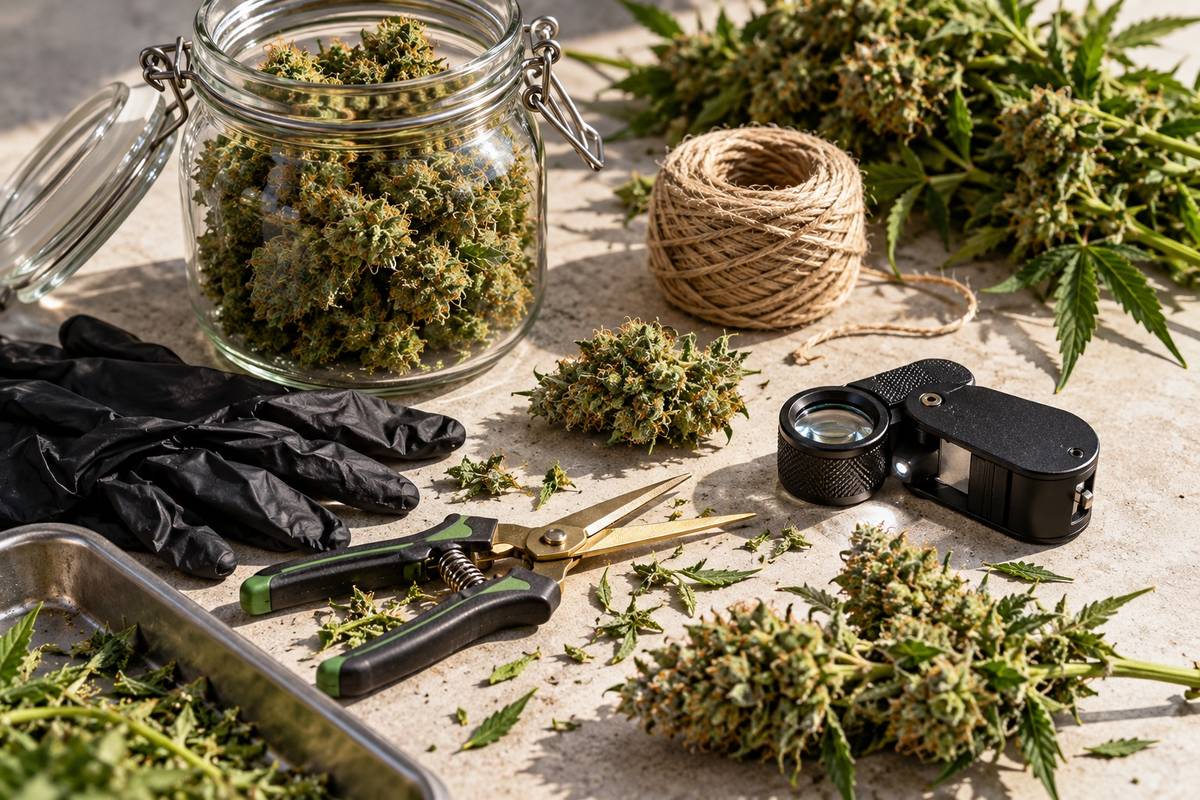
- Prepare your tools: sharp scissors or trimming scissors, disposable gloves, alcohol to clean the blades, hangers or string, and a dark room at 18–21 °C (64–70 °F).
- A dark period beforehand — optional: some growers leave the plant in the dark for 24–48 hours to “concentrate” resin and terpenes. To be honest: the effect is not proven, but it doesn’t do any harm either. Far more important is not to feed in the last days.
- Flushing: whether watering without nutrients in the last 7–14 days improves the taste is debated. In soil you can skip it if you have fed cleanly; in hydro and coco it is still standard.
- Whole plant or branch by branch? Cut small plants at the main stem and hang them whole — they dry more slowly and evenly. Take big plants apart branch by branch; ripe top buds can also be harvested a few days before the lower ones.
- Wet trim or dry trim: with a wet trim you remove fan and sugar leaves straight after cutting — faster, lower mold risk, but the resin is sticky. With a dry trim you trim only after drying — slower, but gentler on the aroma. In damp autumn weather, wet trim is the safer choice.
- Hang: branches upside down, spaced apart, out of direct light. From now on the second half of the harvest begins: drying.
After the harvest: drying and curing
Freshly cut buds contain about 75% water. They are dried slowly and in the dark: 18–21 °C (64–70 °F), 50–60% humidity, 7–14 days, with gentle air movement but without a fan blowing straight at the buds. They are ready when small branches snap when bent instead of bending. Drying too fast in warm air is the most common reason for a harsh, hay-like taste — the breakdown of chlorophyll needs time.

Then comes curing: the dried buds go into airtight jars, which you open briefly every day in the first week and every few days later on. After two to four weeks aroma and effect are much smoother. All the details on time, temperature and methods are in our full guide How to dry and cure weed. And if you have seeds left over for next season: here is how to store cannabis seeds properly.
Common harvesting mistakes
- Harvesting by the pistils instead of the trichomes. Brown hairs alone say little — in heat or under stress they change colour weeks too early.
- Checking trichomes only on the sugar leaves. They ripen there first; what counts are the glands directly on the calyxes.
- Taking the strain’s flowering time as a fixed date. “60 days” applies under ideal conditions. Under weak light or in a cool autumn it takes longer.
- Waiting outdoors for the perfect window. A long spell of rain forecast for October is more dangerous than harvesting three days early — bud rot can destroy a harvest overnight.
- Drying too warm and too fast. The best harvest time is wasted if the buds dry in three days on the radiator.
Strains that ripen safely in a short season
The easiest way to a clean harvest is a strain that suits your climate. For short seasons that means: fast versions for photoperiod genetics with a one- to two-week head start, and autoflowers for balconies, short summers and several harvests a year.
Fast-version strains such as Galaxy Fast and Tutankhamon Fast, or autoflowers such as Auto Tutankhamon and Auto Northern Lights, are ready from late August to mid-September. All seeds come from our own breeding in Barcelona, with a germination guarantee and discreet shipping to the UK, Europe, the USA, Canada and worldwide.
Autoflowering strains need no light switch and ripen regardless of day length — ideal if you sow from May and want to harvest before the autumn rain.
FAQ: When to harvest cannabis
What does cannabis look like when it is ready to harvest?
The buds are dense and swollen, 70–90% of the white hairs have turned orange to brown and curled in, and the big fan leaves are yellowing. You can only be sure with a loupe: 70–80% of the trichomes milky-cloudy and 10–20% amber — then the plant is ready to harvest.
How do I know when my plant is ready to harvest?
When most of the trichomes on the calyxes are milky and the first ones turn amber. The strain’s flowering time is the frame: fast versions 6–7 weeks, indica 7–9, hybrids 8–10, sativa 10–12 weeks of flowering; autoflowers 8–11 weeks from germination. Start checking with a loupe two weeks before the stated date.
How do you harvest cannabis buds properly?
In the morning after the dark period, cut branch by branch with clean, sharp scissors, wear gloves, remove the big fan leaves and hang the branches upside down in a dark room at 18–21 °C (64–70 °F) and 50–60% humidity. Ripe top buds can be harvested a few days before the lower ones.
How do you harvest and dry cannabis plants?
Harvest when the trichomes are milky; then dry slowly and in the dark for 7–14 days until small branches snap. After that, cure the buds in jars for two to four weeks and open the jars every day at first. Drying too fast and too warm is the most common cause of a harsh taste.
Should you harvest cannabis in the morning or the evening?
In the morning, right after the dark period. That is when the terpene content is highest, because some of the volatile aroma compounds evaporate during the day with light and heat. Outdoors, just wait until the dew has dried.
Should you remove the leaves when harvesting?
Yes. Remove the big fan leaves when you cut, and the small sugar leaves either straight away (wet trim — faster, lower mold risk) or after drying (dry trim — gentler on the aroma). In damp autumn weather, the wet trim is the safer choice.
When should you harvest weed outdoors?
In the northern hemisphere autoflowers and fast versions are ready from late August to mid-September, fast indicas in the first half of September, hybrids in mid to late September and sativas in October. In short, wet seasons (UK, northern Europe, Canada, the northern USA) choose strains that finish by mid-September.
How long does it take to grow weed from seed to harvest?
Autoflowers take 8–11 weeks from germination. Photoperiod strains need a vegetative phase of a few weeks plus 6–12 weeks of flowering, depending on the strain — about three to five months in total indoors. Outdoors, photoperiod plants are sown in spring and harvested from September to October.



Comments
No comments yet. Be the first.