

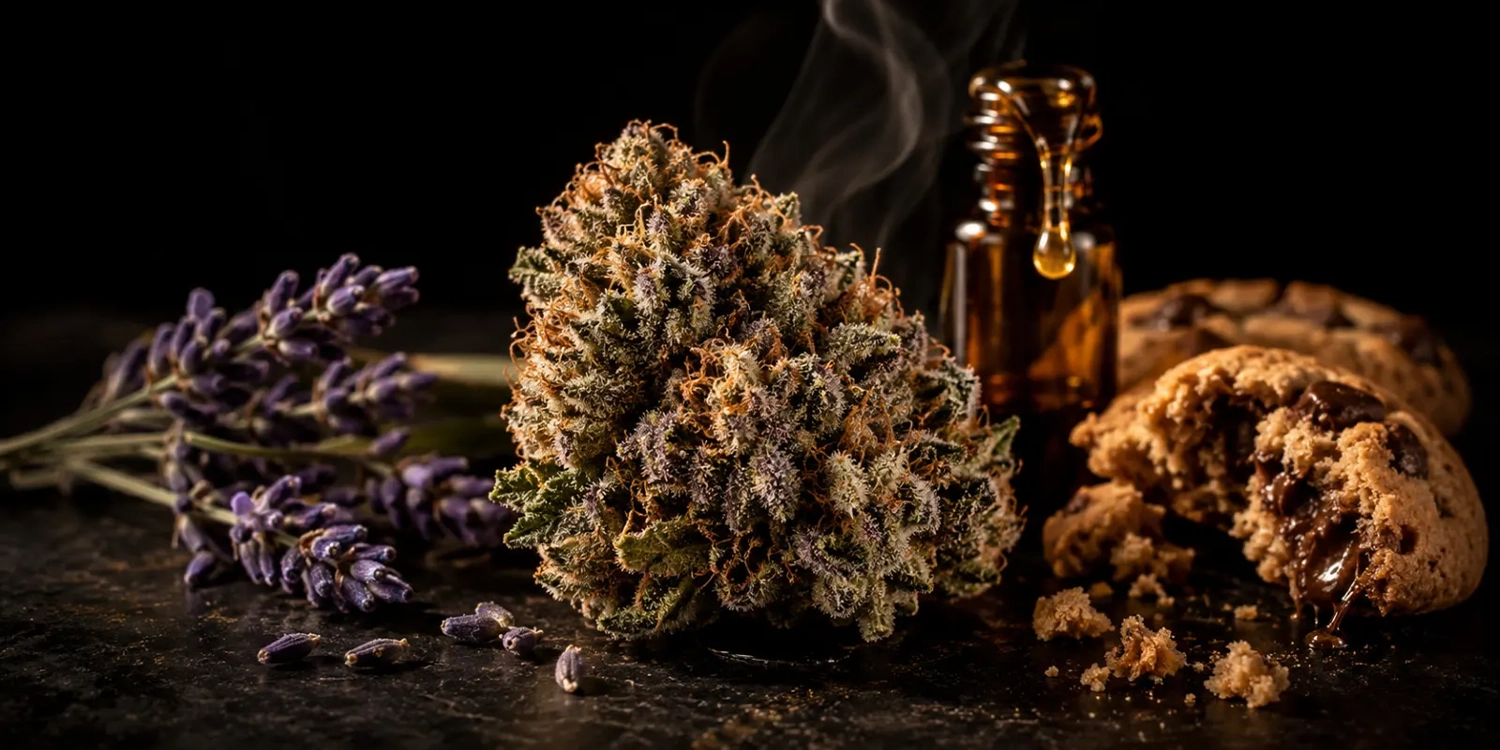
Do-Si-Dos, also written Dosidos or Do Si Dos, is a 70% indica hybrid built from Face Off OG and Girl Scout Cookies. It carries a punchy 25% THC and, unusually for a cannabis strain, leads with linalool rather than the more common myrcene or limonene.
What Is Do-Si-Dos
Do-Si-Dos is an indica-dominant strain from the Girl Scout Cookies family, crossed with Face Off OG. It's known for dense, resin-heavy buds, a creamy, earthy aroma with a floral edge, and a THC level that sits near the top of the Cookies lineup at around 25%.
The name appears in three forms across search and seed catalogs — Do-Si-Dos, Dosidos, and Do Si Dos — and all three refer to the same genetics, just written differently depending on the source. There's also an autoflowering version, Auto Do-Si-Dos, bred from the same line but with its own flowering cycle and a slightly different terpene balance, covered further down.
What tends to surprise people coming from other Cookies-family strains is how the aroma leans floral rather than purely sweet. That's the linalool talking, and it's the first sign that Do-Si-Dos doesn't behave quite like its relatives — a thread this article follows all the way through genetics, terpenes, and the choice between the photoperiod and autoflowering versions.
Do-Si-Dos has also become one of those names strain databases and growers reference constantly when talking about the wider Cookies family, precisely because it sits at the intersection of two well-known lines rather than being a straight descendant of one. That's part of why the genetics below matter more here than in a typical strain writeup — the cross explains almost everything else about how the plant grows and how it smokes.

Genetics: Face Off OG × Girl Scout Cookies
Girl Scout Cookies is one of the most reproduced genetic lines in modern cannabis breeding. Its descendants include Thin Mint, known for a cleaner, mintier edge; Sunset Sherbet, leaning berry and citrus; Gelato, the creamy dessert version most people picture when they hear "Cookies"; and Runtz, the candy-fruity branch. Each one takes the same dessert-like GSC base and pushes it in a different direction.
Do-Si-Dos is the branch that adds Face Off OG back into the mix. Face Off OG is itself a strong, fuel-forward OG Kush relative, well known among breeders for its resin output, and crossing it onto GSC is what gives Do-Si-Dos its signature combination: a sweet, cookie-like base with sharper, gassier notes layered on top. That's the trait that separates it from its sweeter GSC cousins, and it's also where the floral, linalool-forward twist starts to make sense — it's not a straight Cookies descendant, it's a Cookies-OG hybrid.
Because Do-Si-Dos shares a family tree with Gelato, the two are sometimes assumed to be the same thing. They're not — both descend from Girl Scout Cookies, but through different crosses, and the terpene profiles below show just how differently that plays out. A separate phenotype sometimes sold as "Dawgmo Cookies" also gets grouped with Do-Si-Dos online; it shares part of the family tree but isn't the same cut, so don't expect an identical result from it.
Girl Scout Cookies itself is one of the strains that defined the modern hybrid era of West Coast cannabis breeding, which is a large part of why so many later strains — Do-Si-Dos included — trace back to it rather than to an older landrace line. Pairing that base with an OG cut like Face Off OG was a deliberate move toward more resin and a heavier body effect, at the cost of some of the pure sweetness the Cookies line is known for.
For the full breakdown of how this family branches out, see our guide to Cookies cannabis strains, and for more on the other side of the cross, our piece on OG Kush and the Kush family.
Indica or Sativa
Do-Si-Dos is 70% indica and 30% sativa in its photoperiod form. The autoflowering version shifts slightly toward the sativa side, at 65% indica and 35% sativa — enough to show up in a slightly lighter, more focused version of the same high, which we cover in the effects section below.
In practice, that 70/30 split shows up as classic indica behavior at the plant level: a shorter, bushier frame that puts its energy into dense, tightly packed colas rather than long stretchy branches. It's the same structural tendency that makes the buds so resin-heavy — and, as the growing section below explains, part of why airflow around them matters.

Terpene Profile: Why Linalool Is Unusual
Terpenes are the aromatic compounds that give every cannabis strain its distinct smell, and they shape the character of the high alongside THC — a strain led by citrusy limonene tends to feel different from one led by earthy myrcene, even at the same THC level. Most cannabis strains are led by myrcene or limonene. Do-Si-Dos isn't — its dominant terpene is linalool, the same compound that gives lavender its scent, and one that's far less common at the top of a cannabis profile. Linalool is widely associated with an easing of physical and mental tension, which lines up with the calmer, body-heavy side of Do-Si-Dos's effects.
In the photoperiod version, linalool is followed by caryophyllene and limonene. Together they produce the aroma the strain is known for: creamy and earthy at the base, with a floral lift from the linalool and a fruity edge from the limonene, plus the peppery depth caryophyllene tends to add to OG-leaning genetics. It's a more layered smell than a typical Cookies strain, and the floral note is the giveaway that you're smelling Do-Si-Dos specifically, not a generic GSC descendant.
Caryophyllene is worth a mention on its own: it's the one terpene known to interact directly with the body's cannabinoid receptors, which is part of why breeders and growers pay close attention to it when talking about the entourage effect — the idea that terpenes and cannabinoids work together rather than THC acting alone. In Do-Si-Dos, that combination of linalool's calming reputation and caryophyllene's receptor activity is a large part of why the strain reads as heavier and more grounding than its THC number alone would suggest.
Auto Do-Si-Dos swaps that third terpene: instead of limonene, its profile finishes with myrcene, alongside the same linalool-caryophyllene lead. The result is a fruitier, more petrichor-like scent with a hint of the original Cookies base — and an effect that stays relaxed without tipping into sedation. Two versions of the same genetics, two different terpene outcomes, which is not something you'll find written up anywhere else.
Effects
Do-Si-Dos opens with a euphoric lift before settling into a heavier, more relaxing body effect — the linalool-and-caryophyllene combination doing what it does best. Give it enough time and the sedative side takes over fully. Honestly, this is an evening strain: something to reach for once the day's obligations are done, not before them.
The autoflower keeps the euphoria and the relaxation but leaves most of the sedation behind, landing closer to a focused, easy-going high than a couch-lock one — a direct result of the myrcene-over-limonene swap in its terpene profile. If the photoperiod version is for winding all the way down, the autoflower is for winding down without necessarily switching off for the night.
THC Level
Do-Si-Dos tests at around 25% THC in its photoperiod form, with CBD staying low, under 1% — so this isn't a strain built around a balanced THC:CBD ratio, it's built around potency. The autoflowering version runs slightly lower, at 20–23%.
Those numbers are a ceiling reached under optimal growing conditions, not a guarantee. Actual THC in the finished flower depends on light intensity, feeding, harvest timing, and how carefully the buds are dried and cured afterward. Two growers with the same seeds can end up with noticeably different lab results depending on how those variables are handled.
Growing: Flowering Time, Yield, and Difficulty
Indoors, the photoperiod version finishes flowering in 55 to 60 days; switch to LED lighting and that drops to roughly 48 to 53 days, since LED spectrums tend to push flowering plants through their cycle faster than older HPS setups. Indoor yields run 500 to 550 g/m², climbing to 850–900 g from a 1.5 m² space under a 720 W LED setup. Outdoors, expect 0.75 to 1 kg per plant, with harvest landing in September in the Northern Hemisphere (growers south of the equator — Australia, Chile, Argentina, Uruguay, Brazil — should plan for a March harvest instead).
Difficulty sits at Moderate. That doesn't mean fussy — the plant holds its structure well and doesn't demand constant fine-tuning — but the dense, resin-heavy colas that make Do-Si-Dos worth growing also trap humidity, so airflow and moisture control around the buds matter more here than on an easier, airier strain. Regular defoliation around the lower canopy and a dehumidifier during the last few weeks of flowering go a long way. Early low-stress training also pays off on the indica-dominant structure, opening the canopy up before the plant packs on density later in flowering. It's a reasonable second or third grow, not an ideal first one.
If you're set on growing the photoperiod version, our Do-Si-Dos feminized seeds carry the exact genetics described here.

Do-Si-Dos or Auto Do-Si-Dos: Which One to Choose
The two versions share the same genetic base but diverge enough in cycle, yield, and effect that the choice comes down to what you're growing for and how you want the high to feel. Most databases list them as though they were simply two separate strains; grown side by side, the more useful way to think about them is as one genetic line expressed two different ways.
Someone running a single indoor tent on a tight timeline, or growing outdoors somewhere with a short season, generally gets more out of the autoflower — faster turnaround, no light schedule to manage, and a high that stays usable earlier in the evening. Someone with the space and patience for a longer photoperiod cycle, chasing the higher THC ceiling and the deeper, more sedating effect, is better served by the original Do-Si-Dos.
| Trait | Do-Si-Dos (photoperiod) | Auto Do-Si-Dos |
|---|---|---|
| Genotype | 70% indica / 30% sativa | 65% indica / 35% sativa |
| THC | ~25% | 20–23% |
| Flowering indoor | 55–60 days | 65 days from germ. |
| Flowering under LED | 48–53 days | 58 days |
| Indoor yield (per m²) | 500–550 g/m² | 550–650 g/m² |
| Indoor yield (1.5 m² LED) | up to 850–900 g | up to 800 g |
| Outdoor yield | 0.75–1 kg/plant | 250–350 g/plant |
| Third terpene | Limonene | Myrcene |
| Effect character | Relaxing, sedative later | Focused, low sedation |
If you want the strongest THC and don't mind the longer cycle, the photoperiod version is the one to grow. If you'd rather have flower in a couple of months without tracking light schedules — and prefer an effect that stays functional rather than sedating — Auto Do-Si-Dos is the better fit. Either way, you're growing the same Face Off OG × Girl Scout Cookies genetics described above; what changes is the cycle, the yield ceiling, and which terpene finishes the profile.
Between the linalool-led aroma, the OG-cross genetics, and the split between two distinct growing profiles, Do-Si-Dos has more going on than a one-line strain summary can capture. The full specifications for the photoperiod version, including everything covered here, are on the Do-Si-Dos strain page.
Frequently Asked Questions
Frequently asked questions
Is Do-Si-Dos indica or sativa?
Do-Si-Dos is 70% indica and 30% sativa. The autoflowering version, Auto Do-Si-Dos, is 65% indica and 35% sativa.
Is Do-Si-Dos a good strain?
Honestly, yes — it's strong and flavorful, but it's a Moderate-difficulty plant and an evening strain by effect. It suits growers past their first couple of grows and smokers who want a relaxing, end-of-day high rather than a wake-and-bake.
What is the THC level of Do-Si-Dos?
Around 25% in the photoperiod version and 20–23% in Auto Do-Si-Dos. Both figures are a ceiling under optimal growing conditions.
What is Do-Si-Dos made from?
Do-Si-Dos is a cross of Face Off OG and Girl Scout Cookies.
Is Do-Si-Dos related to Gelato?
Yes, distantly — both descend from Girl Scout Cookies, but through different crosses, so they're related rather than identical.
How long does Do-Si-Dos take to flower?
55 to 60 days indoors, or about 48 to 53 days under LED lighting.
Read also


Strains from this article



Comments 1